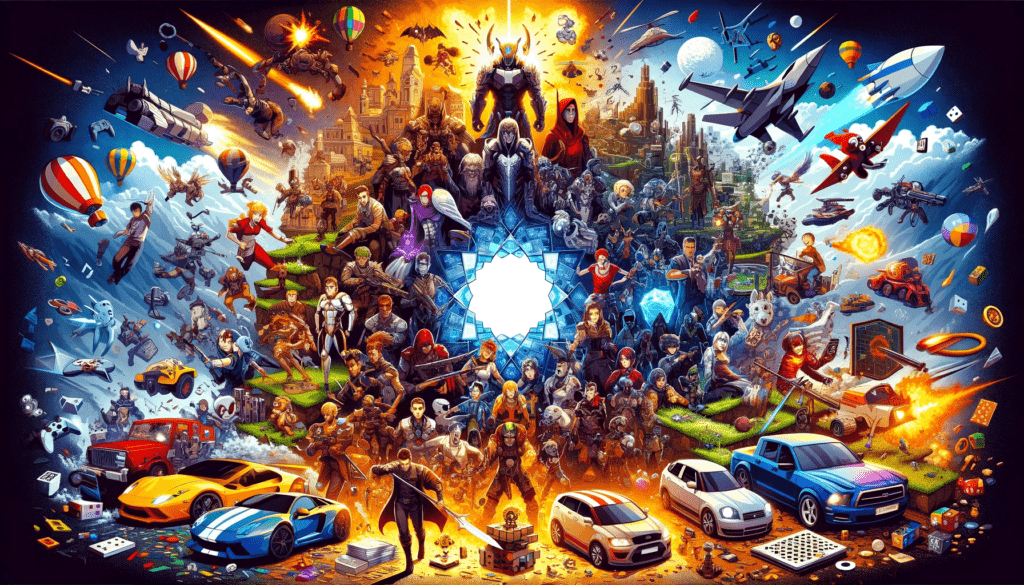
If you've ever tried to describe a favourite game to someone unfamiliar with gaming, you've likely encountered a fundamental challenge: the vocabulary of gaming isn't widely shared. Unlike film, where most people can meaningfully distinguish between a drama, a comedy, and a thriller, gaming genres can feel opaque even to people who play casually. What exactly is an RPG? How does a "roguelike" differ from other games? Why do some players who love strategy games have no interest in real-time strategy, while others prefer nothing else?
This guide is for anyone who wants to understand gaming's genre landscape — whether you're a newcomer trying to navigate the enormous library of available games, or an experienced player looking to articulate what you love about the games you play. We'll walk through the major categories, explain what defines them, trace their history, and identify the kinds of players they tend to attract.
Why Genre Classification Matters (and Its Limits)
Before we begin, a note on the imprecision of genre labels. In gaming, genre terms are used in multiple ways — sometimes describing mechanical systems (how the game is played), sometimes describing perspective (from what viewpoint), sometimes describing subject matter (what the game is about). This can create confusion: an "action RPG" and a "turn-based RPG" may share almost nothing mechanically while both legitimately claiming the RPG label.
Genre labels are most useful as a starting point — a rough signal about what to expect from a game. They should be understood as overlapping, fluid categories rather than rigid boxes. Many of the most celebrated games in history sit deliberately at the intersections between genres, borrowing and blending traditions in ways that create something genuinely new.
First-Person Shooter (FPS)
The first-person shooter is defined by two things: the player's perspective (looking through the protagonist's eyes) and the primary mechanic (ranged combat, most commonly with firearms). It's one of gaming's most popular genres globally, and one of its most technically demanding to execute well.
Origins and Evolution
While earlier games explored first-person perspectives, id Software's Wolfenstein 3D and Doom are commonly credited with establishing the FPS genre in the early 1990s. These games created a template — fast movement, resource management, enemy encounters — that numerous titles would refine over the following decades. Quake introduced genuine 3D environments, while GoldenEye 007 demonstrated that FPS design could work meaningfully on consoles and support sophisticated multiplayer. Halo brought the genre to a mass console audience and introduced mechanics like regenerating health and a two-weapon limit that became industry standards.
What FPS Games Demand
At their core, FPS games require quick reflexes, accurate spatial awareness, and rapid decision-making under pressure. Competitive FPS titles like Counter-Strike and Valorant reward months or years of skill development — the gap between a novice and an experienced player is enormous and clearly visible. Single-player FPS titles typically layer these mechanics with environmental storytelling, pacing, and narrative ambition. The genre's perspective creates an immediacy that few other formats can match: you feel present in these worlds in a way that third-person games don't quite replicate.
Who FPS Games Appeal To
Players drawn to FPS games typically enjoy competitive skill development, the satisfaction of precision, and fast-paced moment-to-moment decision-making. They often thrive in communities built around mastery and improvement. The genre attracts both social players (drawn to team-based competition) and solo players (attracted to narrative-driven single-player campaigns).
Role-Playing Game (RPG)
The RPG is perhaps gaming's most expansive genre designation. Its name comes from tabletop role-playing games like Dungeons & Dragons, and its defining features include character progression systems, narrative focus, and player-driven decision-making about who their character becomes.
The RPG Spectrum
The genre spans an enormous range. At one end, turn-based RPGs like Baldur's Gate 3 and the Final Fantasy series emphasise strategic combat, character building, and rich narrative. At the other, action RPGs like Elden Ring and The Witcher 3 integrate real-time combat with RPG progression systems, creating a blend that appeals to both action-game and RPG audiences. Between these poles sit dozens of hybrid approaches: tactical RPGs, dungeon-crawlers, visual novel RPGs, and roguelite RPGs each representing distinct interpretations of the genre's core ideas.
Character and Story
What unifies RPGs across their many forms is an emphasis on character — on the sense that the person you're playing is someone with a history, developing abilities, and meaningful relationships. Great RPGs give players genuine agency over this character's arc, even if the broad strokes of the narrative are fixed. The experience of building a character over dozens of hours, watching them grow from a vulnerable newcomer into a formidable figure, is one of gaming's most uniquely satisfying progressions.
Strategy Games
Strategy games are defined by their prioritisation of thoughtful decision-making over reflexive action. They ask players to manage resources, plan ahead, and evaluate trade-offs — and they reward those who do this well with outcomes that feel genuinely earned.
Real-Time vs Turn-Based
The strategy genre divides most significantly between real-time strategy (RTS) and turn-based strategy. RTS games like StarCraft II and Age of Empires unfold continuously, demanding that players manage multiple tasks simultaneously under time pressure. The competitive scene around StarCraft II, in particular, represents some of the highest levels of cognitive performance in gaming — professional players execute hundreds of precise actions per minute while maintaining strategic vision across an entire game state.
Turn-based strategy games, including the Civilization series and XCOM franchise, allow players to take as long as they need with each decision. This removes the reflexive pressure of RTS games and replaces it with a more contemplative challenge: given all available information, what is the best possible choice? The Civilization series, with its "one more turn" reputation, has produced some of gaming's most famously absorbed players.
The 4X Subgenre
A particularly beloved strategy subgenre is the 4X — named for its four defining verbs: eXplore, eXpand, eXploit, eXterminate. 4X games typically span centuries of in-game time, asking players to build civilizations, manage diplomacy, develop technology, and ultimately dominate a game world through various possible victory conditions. The genre rewards long-term thinking and adaptability — the ability to revise strategy when circumstances change is as important as the quality of the initial plan.
Sandbox and Open-World Games
The sandbox genre represents gaming at its most permissive. Rather than presenting players with prescribed objectives and a linear path, sandbox games provide tools and environments and then step aside. The player's imagination becomes the primary creative force.
Pure Sandbox vs Open-World
It's worth distinguishing between pure sandbox games and open-world games, though these categories overlap significantly. Pure sandbox titles like Minecraft provide almost no directed objectives — the game world is a canvas, and what players do with it is entirely their choice. Open-world games like The Elder Scrolls V: Skyrim provide a rich content landscape — quests, characters, stories — but allow players to engage with that content in any order and at any pace. Both prioritise player agency, but in different ways.
The Appeal of Freedom
Sandbox games appeal to players who find prescribed narratives limiting. They attract creative and exploratory personalities — people who define their own goals and find satisfaction in the pursuit of self-directed objectives. The most committed Minecraft players have built architectural wonders, functional computers, and working models of natural systems entirely within the game's framework. This kind of self-directed creativity is the genre's defining gift.
Adventure and Narrative Games
Adventure games prioritise story, atmosphere, and exploration over combat or resource management. They are the genre most closely aligned with cinema and literature, and they have produced some of gaming's most powerful emotional experiences.
Point-and-Click Origins
The adventure game has deep roots in gaming history, emerging from text adventures and early graphic point-and-click titles developed by studios like LucasArts and Sierra Entertainment. Games like The Secret of Monkey Island and King's Quest established templates for puzzle-based exploration and character-driven storytelling that influenced the medium for decades.
Modern Narrative Gaming
Contemporary narrative games have expanded dramatically in both ambition and scope. The Last of Us is widely discussed as one of the most emotionally accomplished storytelling achievements in any medium. Disco Elysium reinvented what an RPG could be, creating a game almost entirely about conversation, memory, and the gradual reconstruction of a broken person's identity. Life is Strange and its successors have built devoted followings around intimate character studies and the consequences of choice.
These games ask different things of players than action or strategy titles. Success is less about skill and more about engagement — about paying attention, reading carefully, making choices that feel meaningful rather than optimal. The reward is a kind of emotional investment that action-focused genres rarely match.
The Blurring of Genre Boundaries
Perhaps the most important observation about game genres in 2025 is that the boundaries between them have never been less relevant. Some of the most celebrated recent games resist clean categorisation entirely. Elden Ring is an action RPG with open-world and survival elements. Hades is a roguelite action game with a narrative depth comparable to story-driven RPGs. Disco Elysium is an RPG built almost entirely out of adventure game mechanics.
This blurring reflects the maturity of the medium. After decades of development, game designers have an enormous vocabulary to draw from — they can combine mechanics from multiple traditions to create precisely the experience they're after. For players, this means that genre labels are a starting point, not a destination. The question isn't just "what genre is this?" but "what does this game reward, and is that what I'm looking for right now?"
Understanding the genre landscape gives you the vocabulary to ask that question more precisely — and to find, across the enormous library of games available, the experiences that will resonate most deeply with who you are as a player.