A note on one pitch 10 min read Oct 2026
Dragons' Den · Smart Investing

Two founders. A robot avatar.
Five dragons, silent.

A dark navy screen rolls into the Den showing an AI avatar in a Smart Investing dashboard — $12,487.32 in a demo portfolio, a 72.9% win rate, 248 total trades. Two founders stand in front of it. The dragons do not interrupt. Deborah Meaden leans forward. Peter Jones writes something down. On air, the moment lasts six seconds. In the room, it lasted close to a minute. This is a note on what the edit cut.

The Smart Investing pitch, as cut for broadcast. Infinitys Gaming is independent — not affiliated with the BBC, the CBC, or Sony Pictures Television.

$12,487
Demo portfolio on screen
72.9%
Claimed win rate
248
Trades the dashboard counts
+18.4%
Shown as "current profit"

Figures read directly off the dashboard behind the founders. None of them are context-free. The dragons do not ask about context on air.

The pitch, as it ran on air

The clip is roughly thirty seconds. The founders establish three things: that the product is AI-driven, that it has already generated performance ("the win rate is on the screen"), and — the giveaway word — that it is "an earner." The dragons do not interrupt. The camera cuts to Deborah Meaden in profile, listening. The subtitle at the bottom says "Thompson", then "earner", then "AI from", then "part, it." The sentences in between are not in the broadcast cut.
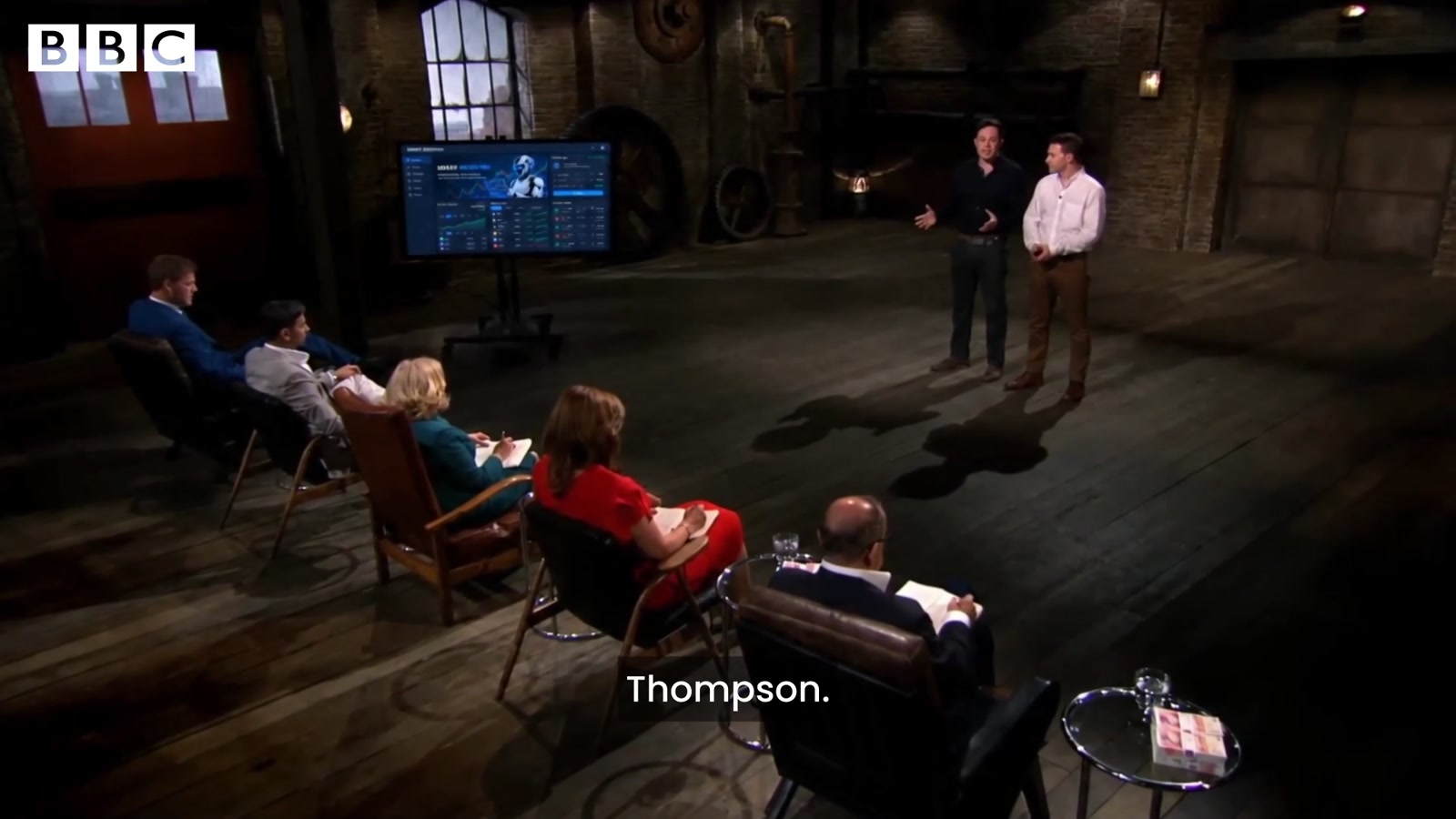
The Dragons' Den with two founders and five dragons seated, a Smart Investing dashboard on screen
00:02 Dragons' Den, standard formation: five seats, a central podium, a product screen. Peter Jones in blue, left. The founders behind the screen, right.

The hour you did not see

A Dragons' Den pitch runs about an hour before the editors get to it, sometimes longer. The televised cut is six to eight minutes. The producers have described this openly in behind-the-scenes material: the pitch is a condensed thing, built out of the raw recording. What is cut is not random. It is the dragons working through the questions that would make the pitch look slower than the show needs it to look.

"Half of the pitches I've invested in on this show, I invested in because of what the founder did in the three minutes after the pitch — not during it." — Deborah Meaden, 2022 BBC Press interview
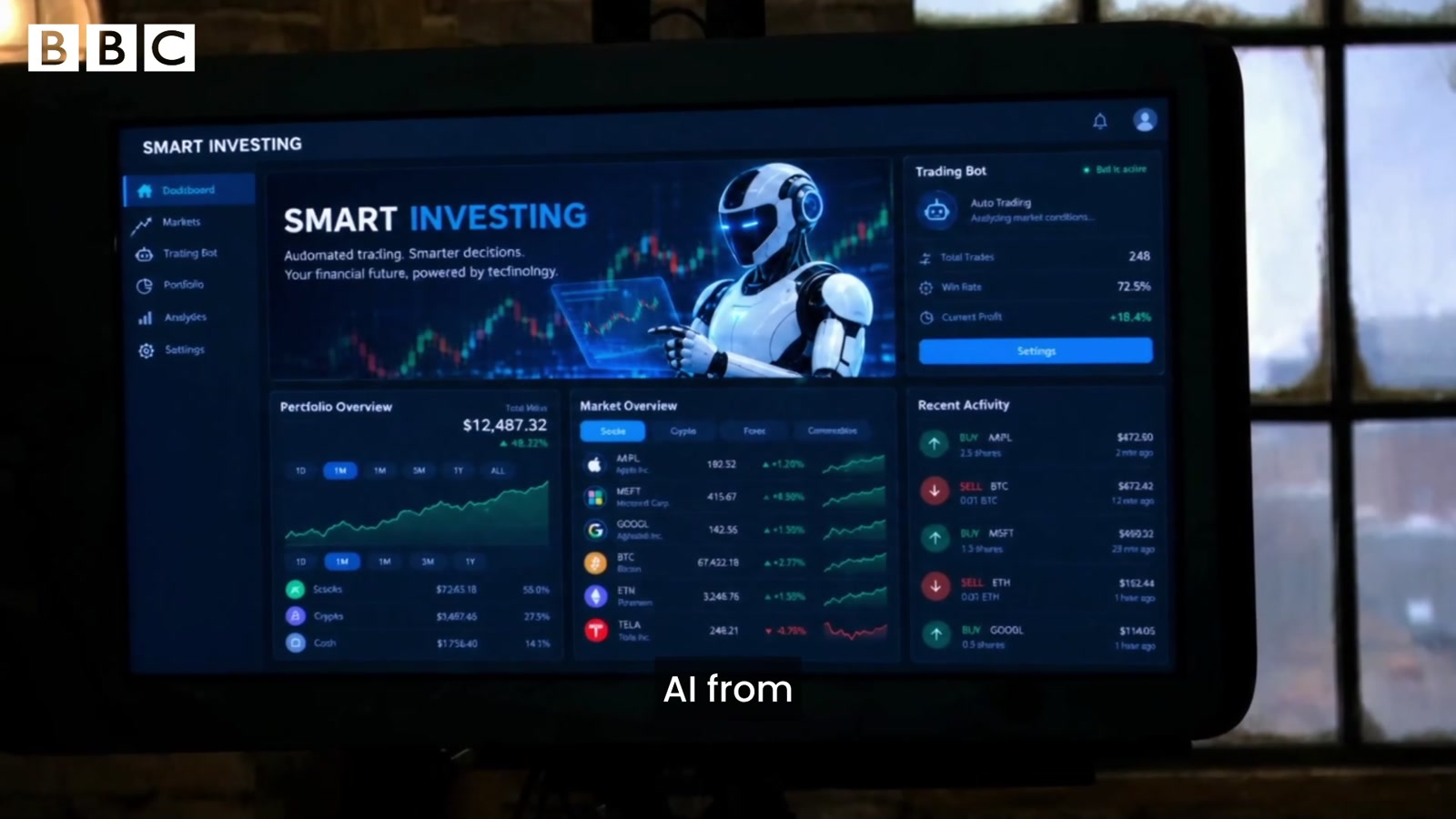
Close-up of the Smart Investing dashboard shown during the pitch, with the AI robot avatar and candlestick charts
00:15 The dashboard. "Smart Investing — Automated trading. Smarter decisions. Your financial future, powered by technology." Note what is missing: timeframe, capital, broker, regulator.

Four things this edit quietly removes

  1. The regulatory question. If this platform executes trades on behalf of UK customers, the Financial Conduct Authority has an opinion on how that is allowed to work. On air, no dragon asks whether the business is FCA-authorised, or whether the founders are proposing to apply, or whether this is a self-directed signal service and the user does the trading. That is the second question in the room. It is not in the cut.
  2. The dashboard provenance. The screen is a product mock-up — an AI-generated robot avatar, polished typography, numbers that end in neat decimals. Deborah almost certainly asked whether a user has ever used this interface to allocate real money, and over what period. The dragons do not ask that on camera.
  3. The off-camera negotiation. A dragon's on-air "yes" is a letter of intent, not a cheque. Diligence happens afterwards. By widely cited alumni counts, roughly 40% of on-air deals close as pitched; some are renegotiated down, some fall apart entirely. The show does not film the breakup call.
  4. The silence after the ask. After the number — the valuation, the ask, the percentage — the dragons often sit in a forty-second silence. Peter Jones is particularly good at this. On air it reads as two seconds. In the room the founder is left standing in that silence, which is the single hardest thing to prepare for.
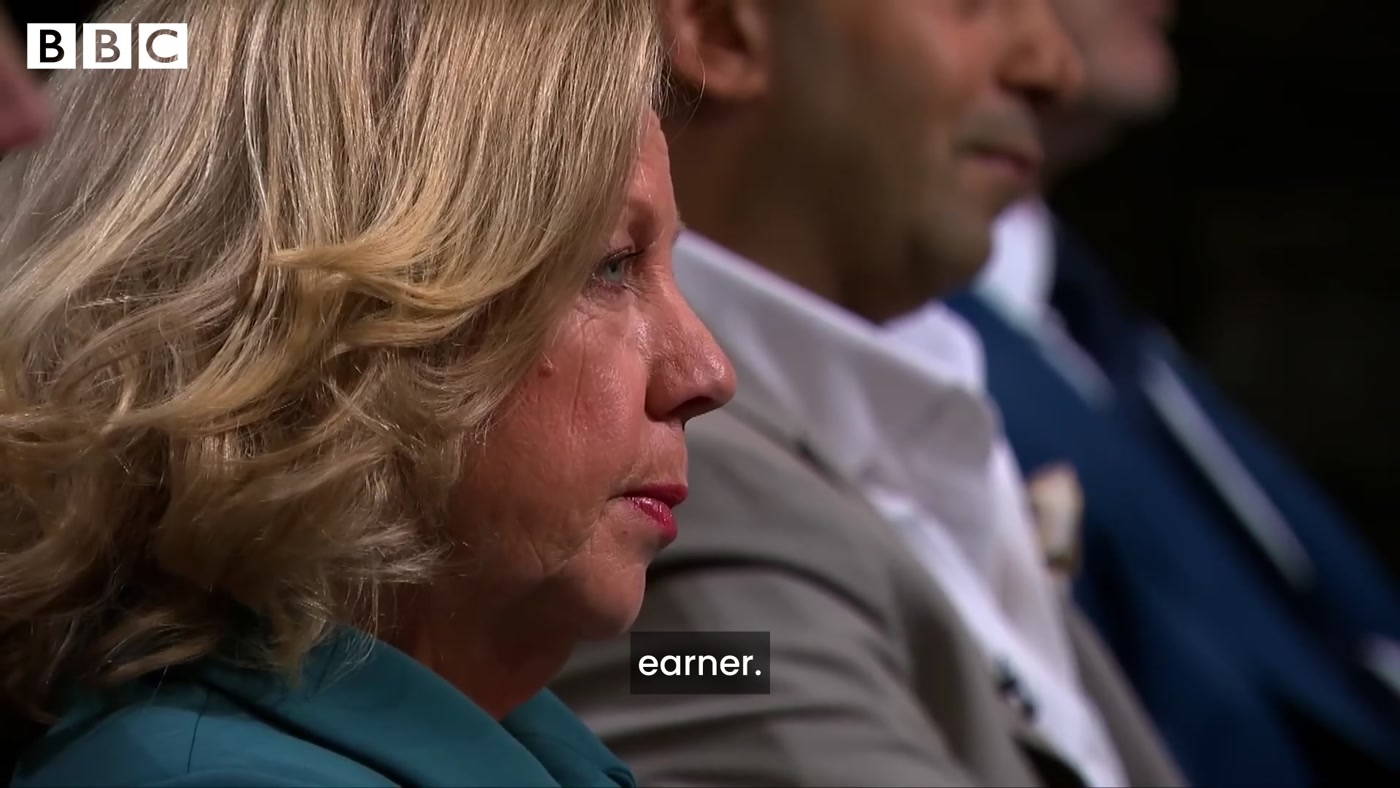
Deborah Meaden in profile, listening to the pitch
00:08 Deborah Meaden, listening. The classic Den tell — chin at rest, eyes not blinking. She is not yet writing. She is deciding whether to.
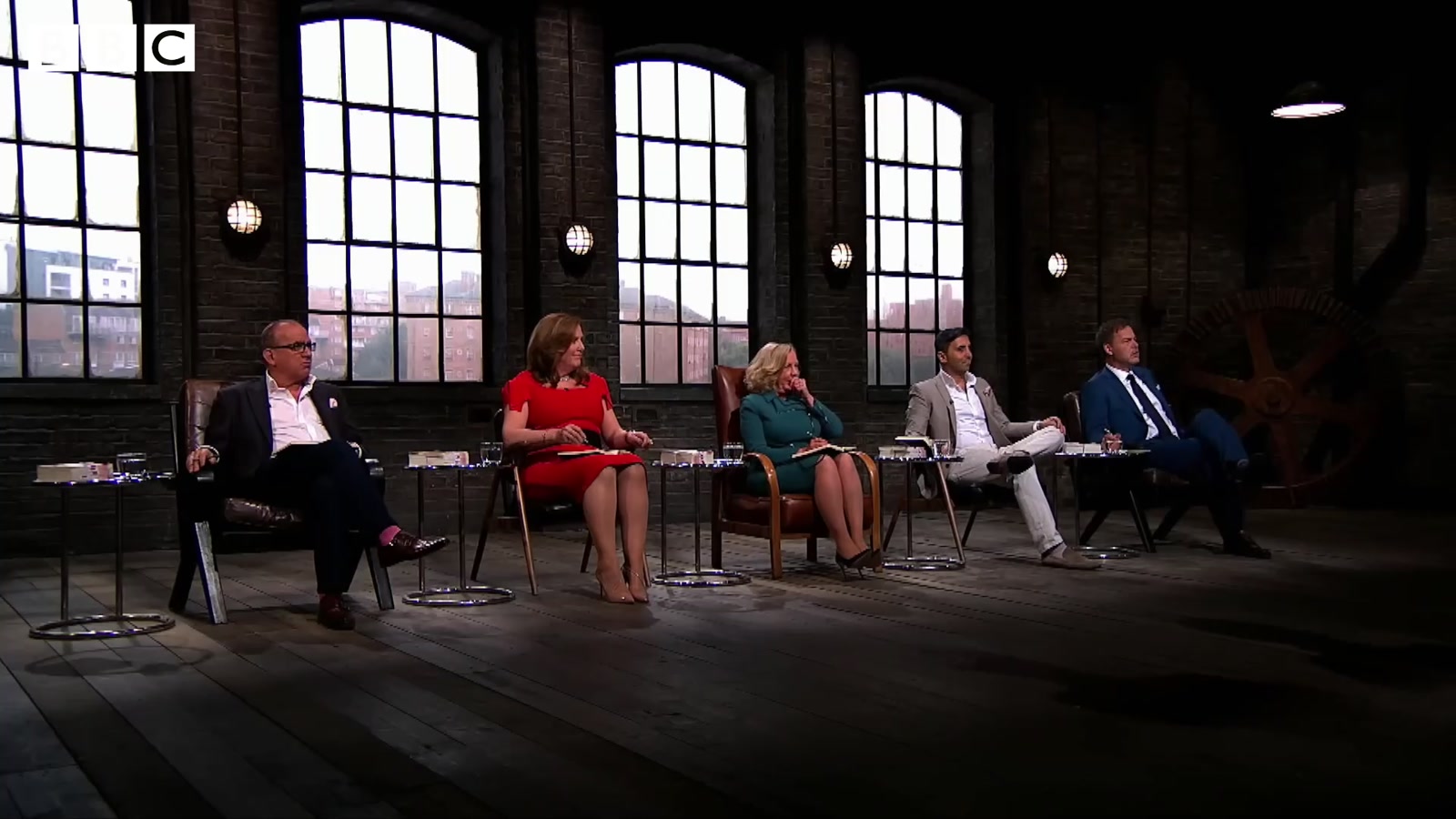
All five dragons seated in the Dragons' Den
00:27 The full row. In the room the follow-up questions have already started — on camera, this is the moment before anyone has spoken.

Reading the five dragons from the clip

You can learn more about a dragon from thirty seconds of body language than from any pitch they ever gave. The four seconds the camera gives you per dragon are mostly editorial choices by a producer; we have slowed the clip and treated it as if we were reading a poker table.

Touker Suleyman
Reclining, hands folded. He has done the maths before the pitch finished and is already looking at the valuation line, not the product.
Peter Jones
Leftmost seat, blue suit, long legs crossed. Writes once, slowly. He writes once because he has already picked the single question that will test the founder.
Deborah Meaden
Teal jacket, chin at rest. She is the operations dragon. The dashboard will not fool her — the compliance question will come from this seat.
Sara Davies
Red dress, pen in hand. She is leaning forward slightly. In the Den, that is a "yes, keep going" signal; it is the dragon most likely to give the founders the benefit of the doubt first.
Steven Bartlett
Rightmost, writing. Steven writes constantly during a pitch. The writing is not notes — it is pattern-matching the pitch against ten other founders he has met this quarter.

Who was actually in the chairs on filming day is a producer's decision we cannot verify from the clip alone. The reads above describe the dragons' usual tells, not their specific actions in this cut.

Why this is on a gaming site

Because the pitch logic is the same. An indie studio asking a publisher for a signing advance is doing a Dragons' Den pitch, dragon-free. The questions are nearly identical: who owns the IP, what's the burn rate, what's the launch window, can you ship on time, and what happens if the lead designer quits. "AI feature" has become one of the standard checkboxes on an indie game pitch deck in 2026 — and that line triggers exactly the same regulatory and provenance questions a Smart Investing pitch triggers in the Den, just in a different vocabulary.

We built a short course on how to walk into the Den — or into a publisher's office — and not fold in the silence. It is below the quiz. The quiz is free.

Three questions, if you have the time

No account. No scoring. Nothing stored outside your browser.

1. The Smart Investing dashboard shows "72.9% win rate" and "+18.4% current profit." What is the single word the pitch is missing?
A win rate without a timeframe is a graphic, not a figure. "72.9% over three months in a bull market" is a different company from "72.9% over three years." In the room, this is the first follow-up.
2. How long is a typical Dragons' Den pitch before the editors get to it?
Alumni from both the UK and Canadian editions consistently describe pitches of an hour or more, with the longest running close to two hours. The six-to-eight minutes you see is a cut from the recording.
3. Which company was turned down by every dragon on the UK Den and went on to become a household name?
Rob Law pitched Trunki on the UK Dragons' Den in 2006 and left without a deal. The brand went on to sell millions of units and became a case study the show itself has publicly revisited.

If you were in the Den for the Smart Investing pitch

£150k for 15%, a demo dashboard, no FCA authorisation yet, "it's an earner." The dragons are quiet. What do you do?

Offer, but conditional on FCA authorisation inside 12 months.22%
Ask to see one real user's three-year track record first.38%
Out. Not an investor in unregulated auto-trading.40%

Click a row to vote. Totals are rolling editorial estimates, not live data.

The commercial bit

Den Craft
— A funding course for Canadian game developers

A six-lesson self-paced course for indie studios in Canada preparing their first funding round. Built from twenty-one series of Dragons' Den, Telefilm and Canada Media Fund application files, and seven real pitch calls between studios and publishers we were allowed to sit in on. One lesson is entirely about the Smart Investing / AI-feature trap: how to put "AI" in your pitch without triggering the regulatory and provenance questions above.

LESSON 01

The 90-second game hook

How to open with the one line that makes a dragon or a publisher ask the second question.

LESSON 02

Numbers that survive 40 seconds of silence

Three figures you must know by heart, and the ones you should not try to answer on your feet.

LESSON 03

The AI-feature trap

How to describe an AI component in your game without triggering the Smart Investing-style follow-up questions.

LESSON 04

Telefilm and CMF, decoded

What the application forms are really asking, and the three sections where most studios lose marks.

LESSON 05

Publisher terms you should never sign

Five specific clauses that look standard and are not, with the exact language to counter-offer.

LESSON 06

The handshake-to-cheque checklist

The eighteen things that happen between a yes and the money actually arriving.

CA$149
CA$49
Launch price · 6 lessons · Lifetime access

Secure checkout. No subscription. Refund within 30 days.

30-day refund
Written for Canada
Lifetime access
No card stored

About this page. Infinitys Gaming is a Calgary-based gaming editorial. We are not affiliated with the CBC, the BBC, Sony Pictures Television, the producers of Dragons' Den, or the founders of Smart Investing. The clip above is used in a short editorial context. The dragon reads, approximate figures and reconstructed questions are editorial observations and estimates, not reports of what was said off-camera.

What this is not. Den Craft is a written and video course. It is not legal, accounting, tax, or investment advice. Nothing on this page is a recommendation to use, invest in, or distribute an AI auto-trading product. Figures described on the Smart Investing dashboard (win rate, portfolio value, current profit) are what appears on the screen in the clip — they are not independently verified. The quiz and poll above store your answers in your own browser only — no account, no tracking pixel.